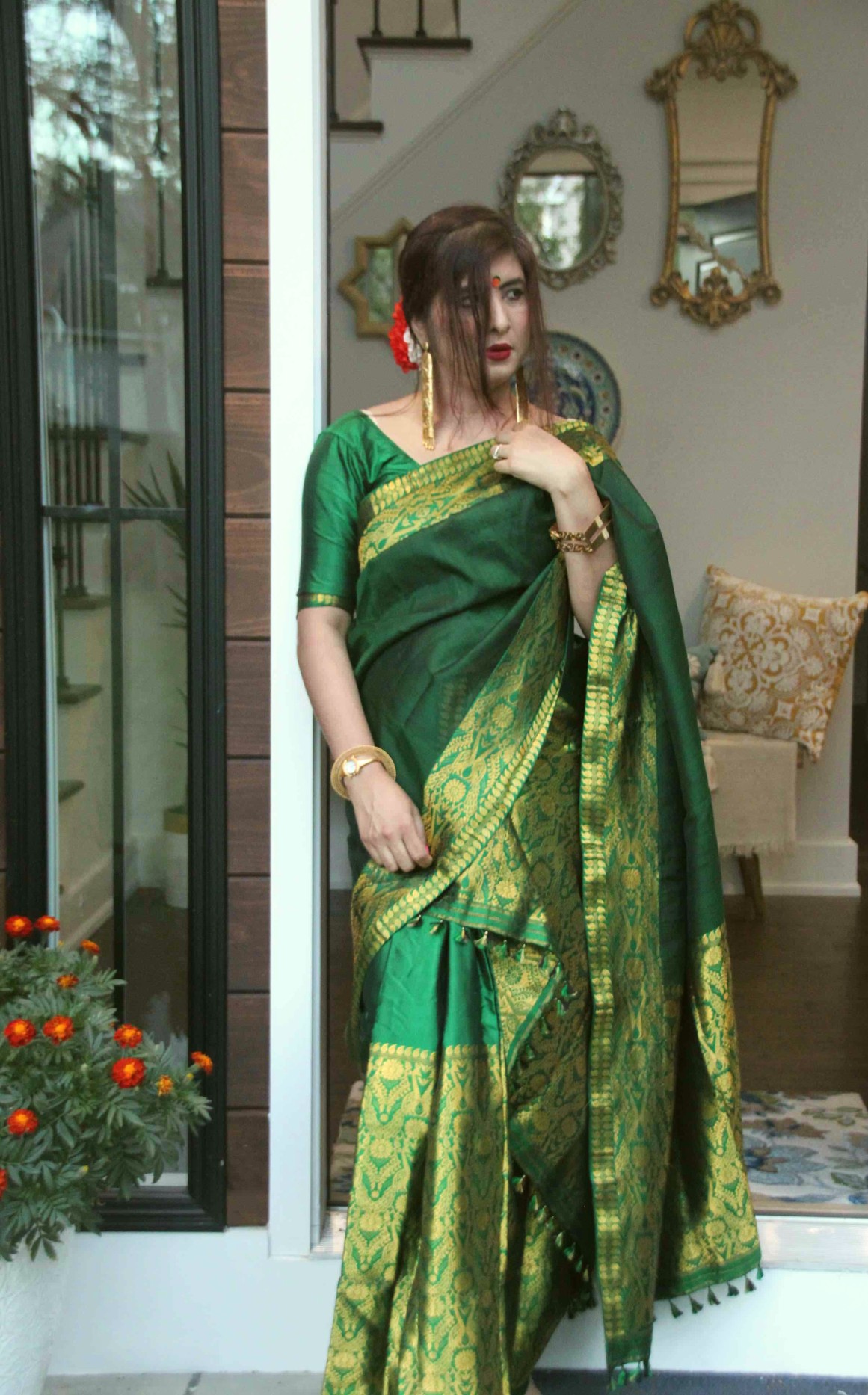
outfit of the day green mekhela chadar


In my current homeland, here in New England, summer is almost over. However, in my other homeland, India, this is the hallmark of the festive season. The festive season unfolds with good food and chances of dressing up. However, COVID-19 has changed everything, including the way we celebrate festivities.


The other day, one of my friends invited us to an Indian festival. I decided to step out of the mundane and dress in something special. Then this pair of green mekhela chadar came to my mind. A quintessential and classic for any Indian wardrobe. Even though this mekhela chadar is traditional, the thick border gives it a very contemporary look. It has a gold peacock motif design. I decided to pair it with a set of muted, statement gold earrings and a large, statement bangle, along with a gold watch. I did a hair bun and wrapped my hair with flowers. For makeup, my lips are in a bold red color, and my eyes are filled with dark kohl. 

How do you like this look? Do let me know. Have a wonderful week ahead and enjoy the festive season.


Comments

Post a Comment

Popular posts from this blog

My favorite pieces of Assamese Traditional jewelry

My grandmother's thuria, age-old and heirloom jewelry, of course, not part-able         A piece of jewelry echoes a region's rich heritage, aesthetics and sensibilities and Assamese jewelry does not differ from that. A piece of jewelry not just enhances the wearer's beauty but identity as well.       A land of flamboyant rivers engulfed in exotic flora and fauna, birds, musical instruments Assamese jewelry is highly inspired by that. Sharing a few assamese pieces of jewelry from my personal collection.       An Assamese bride's dress up is incomplete without Assamese jewelry. Traditionally Assamese jewelry is purely handmade. The main frame is made out with 24-carat gold and lac is used as a filling material. Stones are studded on the top.  The creatively and meticulously studded stone craftsmanship resembles with pomegranate seeds. The color and texture of the stone are opulent and lurid jus...

Jurun...an assamese beautiful pre-wedding ceremony

  Indian weddings encompass many beautiful ceremonies and traditions. In Assamese culture, Jurun is a pre-wedding ceremony. It usually occurs a day or two before the wedding day, sometimes even on the same day of the wedding. A tradition where the groom’s family, especially women, visit the bride's family to present the wedding trousseau (Mekhela chadar), jewelry, some makeup, and accessories. In my belief, a tradition that welcomes the bride to her new family with gifts, love, and blessings.  On the day of Jurun, Aam Dali godha (A stringed mango leaf) is a tradition and is tied over the door. It is believed that it will ward off all bad energy and bring good luck to the newlyweds. Usually, jurun happens in the morning or before noon. The goom does not accompany the group. Before going to the bride's home, the groom and his family get blessings from the people who gather for the jurun. Another tradition associated with Jurun is filling two small bell metal vases (called l...

Five Assamese motifs or designs in Assamese weave

 Assamese weave is one of the most breathable and delicate fabrics in the world. It is very wearable and light to carry in any season. The most falcrom factor of the assamese weave is the designs and motifs that add more aura and beauty to it. Today I want to share a few assamese motifs and styles. Naturally abundant Assam, Assamese motifs are also inspired by flowers, trees, birds, and animals. 1. Kinkhap - The most popular adorned motif in the assamese weave, very regal and resplendent. Traditionally Kinghap motifs weave in gold and silver thread but today you can get it in any thread. It is believed that this design arrived in Assam from the Ahom dynasty. The kinkhap designs consist of two lions facing each other with courage. As Ahom hailed from Thailand, this design got inspired by Thailand. Also, Kinkhap symbolizes the Ahom dynasty's brave, courage and royalty.      There are many who also believe that the word Kinkhap came from China. ...